There was a great piece in Bloomberg a couple of weeks back, part news analysis, part tribute, to the NYC MetroCard which was decommissioned at the end of 2025 in favor of a tap and go system that uses NFCs from a passenger’s credit card, digital wallet, or the Metro’s OMNY card.
I am not one to stand in the way of technology. This move makes sense, it’s the same principle as removing TV screens from the seatbacks on planes, or building paths on well-trodden grass in public spaces – organizations should take advantage of how their constituents already live their lives.
What I was struck by in the piece, and had not known about, was the extensive use of MetroCards for promotion of cultural happenings, events, and advertising:
“The MTA has made more than 400 limited edition cards over the past three decades. They include a tribute to celebrate what would have been Brooklyn-born rapper, Notorious B.I.G.’s 50th birthday in 2022 and one displaying the iconic “I Love NY” logo after Hurricane Sandy struck the region and flooded subway stations in 2013.”
These limited edition MetroCards are collector’s items, and can be found on eBay, Etsy, and the New York Transit Museum Store.
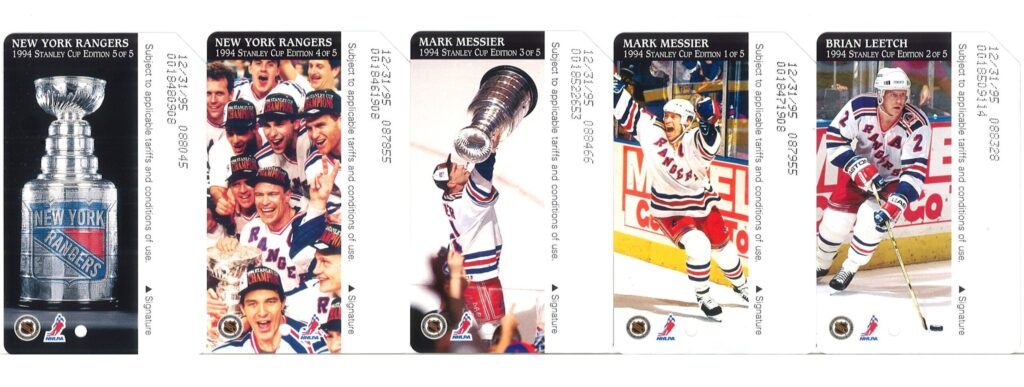
I put things like commemorative MetroCards in the category of useful cultural artifacts, the same category as the postage stamp. These have everyday value and utility, but we (via our institutions) have added cultural value on top through design and celebration. Commemorative MetroCards celebrated New York’s wins, its artists, and its culture and through these small artifacts allowed transit riders to take a small and brief moment to celebrate something that can be broadly categorized as a good cultural thing. In this way, people are gently drawn to a bit of a shared identity, or perhaps, just feel a bit of community pride.
Technological advance is a good thing. Here we’re seeing the replacement of the notoriously finicky MetroCards with what should be a more reliable and efficient payment system. We’re also losing something of a cultural piece of NYC. I’d add that as a society, we too often retreat to our phones and move through a world full of other people, and are entirely focused on whatever is on the screen in our hands, and how we’re represented in that world. A change like this, from paper and challenge and shared culture, to the seamless, quick, and solitary, only furthers that juxtaposition.